
In discussions about shaving, safety razors are often placed in a somewhat contradictory position: they are seen as a more traditional tool, yet simultaneously perceived as requiring a higher learning curve. This contradiction is not unfamiliar to those new to traditional shaving—on the one hand, evaluations of safety razors often focus on being “more controllable” and “gentler”; on the other hand, the psychological pressure of exposed blades makes people hesitant to actually try it.
In fact, most hesitation stems not from the use itself, but from a lack of understanding of its working logic and learning path. When a tool’s behavior becomes clear and predictable, its perceived “difficulty” often decreases rapidly. This is precisely the core problem this complete safety razor beginner’s guide aims to solve: not to teach you how to achieve a perfect shave, but to help you build sufficient cognitive foundation and operational confidence, making your first use controllable and predictable.
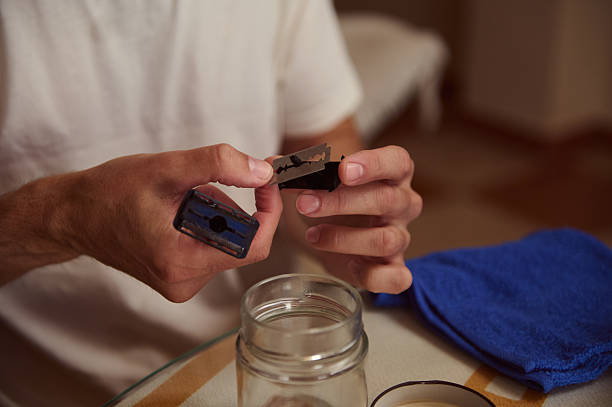
Safety A razor’s safety doesn’t rely on “protection,” but on its structure.
Compared to modern multi-blade systems, the safety razor’s design is remarkably straightforward: a single blade, fixed within a defined head structure, mechanically restricting its exposure angle and cutting path. It is this “restriction” that constitutes the core value of the safety razor.
From a usage perspective, the safety razor’s security primarily comes from three aspects:
Single-blade cutting: Each shaving motion only effectively cuts the beard once, without repeatedly pulling on the skin surface.
Fixed blade exposure: The exposure is determined by the structure, not by user pressure, which greatly reduces the probability of irritation caused by improper force by novices.
Handle weight assist: The weight of the handle itself bears most of the pressure, reducing the need for active hand force and lowering the risk of unstable operation.
In many user reviews of the safety razor for beginners, a recurring experience is that shaving becomes more stable when users realize they “don’t need to apply force.” This isn’t an improvement in technique but rather a natural behavioral adjustment that arises from understanding how the tool works.

How does blade design affect the shaving experience, not just its “sharpness”?
When first encountering a safety razor, many people focus entirely on the sharpness of the blades. However, in actual use, sharpness is only one of many factors affecting the experience. The thickness and flexibility of the blade, as well as how it is secured within the blade head, all directly impact stability during the cutting process.
When the blade remains stable during a cut, the beard is cleanly severed, naturally reducing friction and pulling on the skin. Conversely, if there are tiny vibrations within the blade’s structure, even a fairly sharp blade can easily cause discomfort. This is why many first-time safety razor shaving reviews mention “sound changes”—a stable cut is often accompanied by a clear, continuous shaving sound.
From this perspective, the safety razor is not designed for extreme sharpness, but rather to ensure that every cut occurs within a predictable range. A sense of security is gradually built up through this repetitiveness and consistency.
What beginners really need to master is the order, not the techniques.
Searching online for “how to use a safety razor” easily yields numerous instructions on angles, directions, and number of repetitions. However, for beginners, exposing themselves to these details too early can actually increase psychological pressure. Experience shows that the key to successfully adapting to a safety razor lies not in mastering a large number of techniques but in following a reasonable learning sequence.
In the initial stages, the goal should be very clear: to achieve a shave that doesn’t overly irritate the skin, rather than pursuing an extremely close shave. This means shaving only in the direction of hair growth and accepting a result that isn’t completely clean. Only after this basic operation becomes natural will the user gradually develop a sense of the blade angle and contact feedback.
As usage increases, many people find themselves no longer consciously thinking about angles but rather judging whether they are in the right cutting position through changes in resistance, sound, and touch. This shift from “thinking about operation” to “feeling about operation” is the most important step in the safety razor learning curve.
Common misconceptions often stem from incorrect psychological expectations.
In discussions about beginner safety razor guides, a recurring phenomenon emerges: the real reason people abandon traditional shaving is often not cuts, but frustration. This frustration usually stems from unreasonable expectations.
They believe that being “careful enough” equals being “safe enough,” but they overlook the fact that excessive tension can affect the stability of their movements.
Using “thoroughly clean” shaves as the standard of success ignores the fact that a safety razor is better suited for multiple, lightweight shaves.
Treat all discomfort as failure and ignore normal feedback during the skin’s adaptation process.
Once these expectations are adjusted, the user experience with the safety razor often undergoes a significant transformation. The tool itself hasn’t changed; what has changed is the user’s understanding of the process.

Building trust through controllability is the true value of traditional shaving.
The appeal of the safety razor lies not in representing the past, but in offering a different way of control. When the shaving process no longer relies on the automatic judgment of a complex system but is based on clear mechanical logic, users are more likely to form stable expectations.
This sense of trust isn’t built in a single shave but rather gradually formed through repeated use. If you wish to further understand how the safety razor affects skin condition and the overall shaving experience in practice, you can read related shaving habit analyses to supplement this understanding from different perspectives.
Safety Razor doesn’t require you to become a pro; it allows you to take your time.
Safety A razor is never a tool that requires “talent.” What it truly demands is understanding, patience, and respect for the process itself. When you stop rushing to prove whether you “know how to use it” and instead focus on every controllable operational feedback, the so-called learning curve will naturally disappear.
Perhaps the real question isn’t whether the safety razor is suitable for beginners, but whether we’re willing to allow enough room for adaptation for a more predictable and controllable daily experience.
FAQ: Safety Razor Frequently Asked Questions for Beginners
Q1: Will the safety razor cut my skin?
A: It takes some getting used to at first, but due to its single-blade design and blade-fixing structure, it’s actually safer than multi-blade ones. The key is to maintain the proper angle (about 30°) and use light pressure.
Q2: How long does a safety razor blade last?
A: Depending on beard thickness and shaving frequency, a blade can be used 5-7 times. Proper care can extend its lifespan and maintain a consistent shaving experience.
Q3: How can a beginner quickly get the hang of the safety razor?
A: Focus on the order, not the technique. For your first shave, simply shave lightly in the direction of hair growth, without trying to get a close shave; develop a feel for the blade angle and texture through repeated practice.
Summarize
Safety A razor isn’t a retro gimmick; it’s a tool that makes the shaving process more controllable and predictable. By understanding its design logic, mastering the basic sequence, and adjusting your expectations, even beginners can establish a consistent shaving experience. It doesn’t require skill but rather patience and understanding—once you get used to it, you’ll find that every shave becomes easy, safe, and satisfying.