Safety Razor Pain Point Diagnosis: Differentiating between “scratches” and “burns” is key to effective treatment.
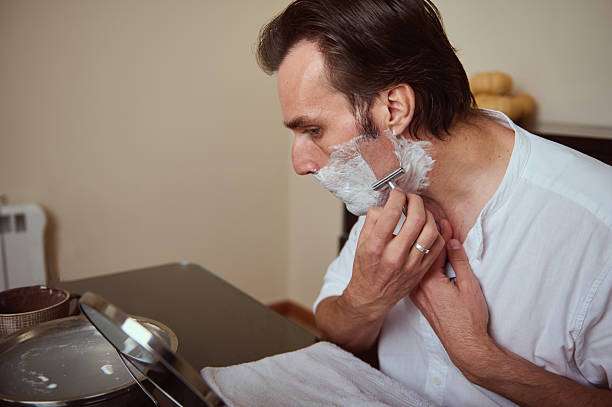
For newcomers who have just switched from multi-head razors to safety razors, the first few weeks are often accompanied by a “bloody romance.” You expect silky smooth “baby skin” (BBS—Baby Butt Smooth), but in reality, you might see two pieces of tampons on your chin, or your neck as red as if it had just been sanded.
Faced with this sense of frustration, most people’s first reaction is to blame the tool: “This knife is too sharp” or “This blade is not suitable for me.”
But before you decide to throw your expensive gear into a drawer, take a moment to do a “forensic examination.” Not all pain is created equal. In the world of wet shaving, nicks and razor burns are two distinct types of injuries, each pointing to a completely different operational error.
If you can’t accurately distinguish why your face turns red after shaving and why you bleed, you’ll never be able to correct your muscle memory. Today, we’ll break down the physical mechanisms behind these two issues and provide targeted solutions.

Symptom 1: Nicks (punctate scratches/cuts)—The cost of lateral movement
Identify symptoms:
This is usually a clear, pinpoint wound, with bright red blood oozing out rapidly. The pain is sharp and instantaneous. You can usually tell exactly which cut caused the problem.
Pathological analysis:
The safety razor’s blade is extremely thin and incredibly sharp. It is only a safe scraping tool when moved perpendicular to the blade. The moment your hand makes even a 1-millimeter “lateral movement,” it instantly transforms into a scalpel.
Razor cuts can lead to serious bleeding:
- Unsteady hand: The wrist shakes at the moment of cutting or retracting the blade, causing the blade to slide laterally.
- Complex terrain: Your face is not smooth; it has pimples, scars, or small bumps. When a straight blade encounters a bump, if it doesn’t avoid it, the blade will cut off the bump directly.
Correction: Lock the wrist
To solve this problem, you need to practice “robotic “arm”-style knife movements. Lock your wrist and use only your elbows and shoulders to drive the arm movement. Make sure each swing is a straight up-and-down motion. For areas with acne, don’t try to shave it all off in one go; instead, learn to “skim over water”—reduce pressure or simply avoid it altogether.
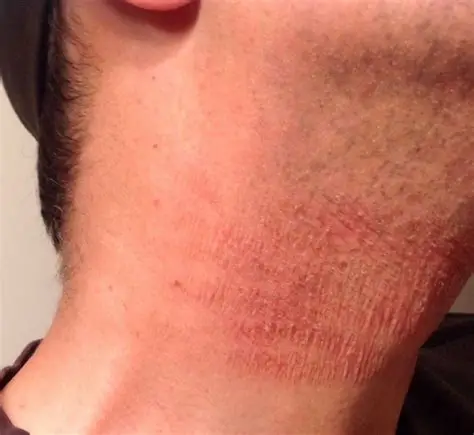
Symptom 2: Razor Burn—A consequence of stress
Identify symptoms:
This is usually not a specific wound but rather a large area (commonly on the neck) that appears diffusely red. You may not feel anything immediately after shaving, but after a few minutes you will start to feel a burning sensation on your face after shaving, and in severe cases, it may be accompanied by a rash and fever.
Pathological analysis:
If Nicks is about “cutting,” then Razor Burn is about “shaving.” This is because you’re removing not only the beard hairs but also several layers of healthy skin cells.
The culprits behind this phenomenon are usually
- Too Much Pressure: This is the hardest habit for multi-head users to break. Multi-head blades require pressure to contact the skin, while the safety razor only needs to be gently placed on the skin. Any extra downward pressure will cause the blades to dig into the skin.
- Wrong Angle: If the handle is tilted too high (the angle between the blade and the skin is greater than 45 degrees), the blade is not “cutting” the beard but “scratching” the skin. This scraping will lift the stratum corneum and expose nerve endings.
- Repeated scraping: repeatedly scraping the areas where no foam has been applied (blade buffing), which is equivalent to dry scraping the skin.
Corrective measures: Adjust angle and reduce pressure
To avoid razor burn, you need to recalibrate your shaving angle adjustment.
In this industry, we have a golden rule called “Ride the Cap”:
- Place the safety razor’s rounded top cap against your face, at which point the handles will be almost perpendicular to your face.
- Slowly tilt the handle downwards until you feel the blade just touch your beard.
- Stop tilting. That’s the perfect 30-degree chamfer.
Throughout the shaving process, let the weight of the razor handle do the work; your hands are only responsible for guiding the direction, and you should not apply any pressure to your face.
Emergency loss mitigation: What to do after an accident occurs?
Even seasoned professionals make mistakes. When damage has already occurred, proper handling can allow you to face others the next day.
For Nicks (to stop bleeding):
Don’t stick toilet paper on your face; it’s unhygienic and unsightly. You’ll need a styptic pencil or an alum block. These contain aluminum sulfate, which has strong astringent properties that instantly coagulate blood and kill bacteria. Although there will be a sharp stinging sensation when you apply it (we call it “honest sting”), the bleeding will stop immediately.
For Razor Burn (Sedation):
Never use aftershave spray containing alcohol; it’s like rubbing salt into a wound. What you need is to rinse with cold water (to constrict capillaries), then apply aftershave balm containing aloe vera, witch hazel, or chamomile. Let your skin rest for the next 24-48 hours; don’t force a smooth finish by shaving again.
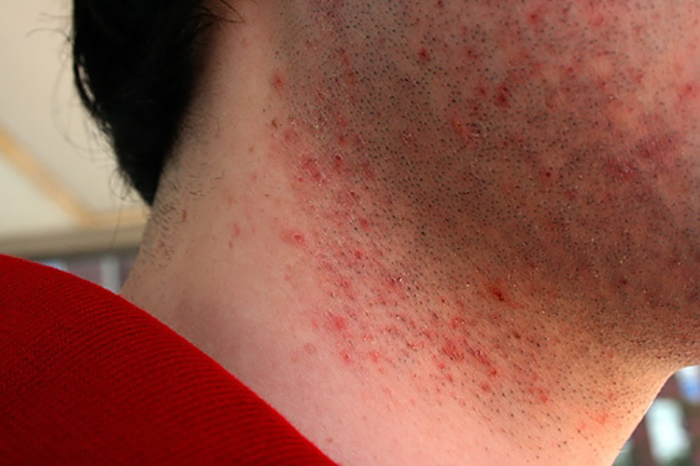
Pain is the best teacher
Don’t be afraid of the occasional stinging from the safety razor. On the learning curve of wet shaving, pain is your body’s immediate feedback.
If you experience sharp pain and bleeding, tell yourself, “Keep your hand steady and don’t move it sideways.”
If it’s burning and swollen, tell yourself, “It’s too heavy; be lighter, and adjust the angle.”
By learning to interpret these signals, you can evolve from a clumsy beginner into a grooming master capable of wielding a sharp blade. Remember, every perfect shave is a delicate reconciliation between you and the razor.
FAQ (Frequently Asked Questions)
Q1: Will a dull blade cause razor burn?
Absolutely. When the blade becomes dull, it won’t cut your beard cleanly; instead, it will tug. To shave cleanly, you’ll unconsciously increase pressure or repeatedly shave the same area, leading to severe post-shave burning. If you feel a pulling sensation on the blade, replace it immediately.
Q2: Why do I always get razor burn on my neck?
The neck is a major problem area for two reasons: first, the skin on the neck is thinner and more sensitive than on the face; second, the growth direction of beard hairs on the neck is extremely irregular (there may be whorls or horizontal growth). The solution is to first use your fingers to feel the beard grain, and the first shave must be done with the grain. Never try to shave against the grain on the neck unless your technique is already very advanced.
Q3: Can using pre-shave oil reduce scratches?
Pre-shave oil primarily increases lubrication, significantly reducing friction between the blade and skin, thus lowering the risk of razor burn. However, its effectiveness is limited for nicks (physical cuts) caused by hand tremors. Preventing scratches remains primarily about controlling hand movements and maintaining the correct contact angle.