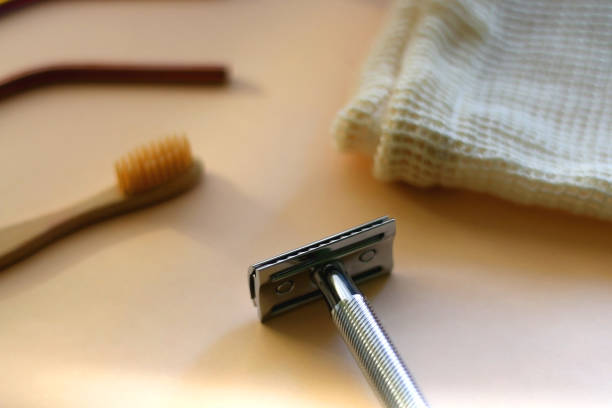
Not just for men: How can women achieve silky smooth legs with a safety razor?

When it comes to hair removal, we seem to be trapped in the vicious cycle of “the more the better” by modern consumerism. Supermarket shelves are flooded with plastic razors with five, six, or even seven blades, claiming that the more blades, the cleaner the hair.
But if you’re experiencing recurring strawberry legs, annoying ingrown hairs, or feeling guilty about the non-biodegradable plastic waste you produce every month, then it’s time to re-examine that traditional tool labeled “for men only.”
That’s right, we’re going to talk about safety razors.

Don’t be misled by gender labels: Why women need safety razors more
For a long time, marketing has led us to believe that women’s skin needs “gentle protection,” resulting in multi-layered blades encased in thick lubricating strips. However, this is precisely the root cause of skin problems.
The Science Behind Saying Goodbye to Strawberry Legs
Multi-blade hair removal systems work on the principle of “stretching and cutting”: the first blade hooks the hair and pulls it out of the pore, while subsequent blades cut it before it retracts.
While this provides a brief period of extreme smoothness, the haircut is often below the skin’s surface, making it prone to getting trapped under the skin when it tries to regrow, leading to ingrown hair or folliculitis.
In contrast, the safety razor uses a double edge (DE) blade. It cuts hair with a single, high-quality kerf without pulling on the follicle.
For women seeking zero-waste shaving, this is not only an environmentally friendly option but also the ultimate solution to the long-standing skin sensitivity issue on the recommended list of body hair removal tools.

For large-area body hair removal: Why a long handle is Key
Women face vastly different challenges when shaving their legs with a safety razor compared to men. We need to work on the legs, underarms, and even the bikini area—areas with large curves and expansive surfaces—and this is often done in the shower.
The Art of Leverage and Manipulation
For beginners, I highly recommend choosing the long-handle design.
Physical center of gravity: The longer handle better balances the weight of the blade. When using the safety razor, the core principle is to “utilize the tool’s own weight,” rather than applying pressure as you would with a plastic knife. The long handle provides better leverage, allowing for greater ease of use when working on blind spots such as the back of the calf.
Anti-slip grip: Premium, women-oriented safety razors typically feature enhanced textured handle designs. In a soapy bathroom, a stable grip means safer handling and avoids unnecessary scratches.
Choice of cutter head opening and closing structure
When searching for answers to whether women can use old-fashioned razors, you’ll find distinctions between “butterfly open” and “three-piece” razors.
Butterfly Open: Simply rotate the bottom to open the blade cover like butterfly wings, making it extremely quick to change blades, perfect for women who value convenience.
Three-piece: The most stable structure and easy to clean thoroughly. Because it has no moving mechanical parts, this type of handle can be passed down through generations, making it the longest-lasting recommended body hair removal tool.

From Plastic to Metal: A Practical Guide to Silky Hair Removal
The shift to eco-friendly shaving for women is not just about changing tools but an upgrade to the ritual of self-care.
Softening and Pretreatment
Never dry shave. Use the heat of your shower to soften your hair for at least 5 minutes. For the ultimate experience, try using shaving soap or shaving oil, which provide a much longer-lasting lubricant layer than supermarket spray foam.
Find the 30-degree angle
This is the gold standard for safety razors: the blade should be held at approximately a 30-degree angle to the skin. Unlike plastic blades, you need to control the angle yourself.Experts recommend: First, place the blade flat against your skin, then slowly tilt the handle until the blade just touches the hair—this is your optimal cutting angle.
Short, gentle gliding
Do not attempt to scrape from the ankle to the groin in one go. Use short, quick strokes (about 5-10 cm) and keep your hands relaxed.Remember: do not apply pressure. Let the weight of the metal do the work.

A Win-Win Situation for Economics and Ecology: The Truth Behind Zero-Waste Hair Removal
Many people hesitate when buying a high-quality safety razor for the first time due to its price (typically between $30 and $80).
But let’s do the math:
| Category | Cost | Notes |
|---|---|---|
| Traditional consumables | A box of four five-blade blades may cost $20. | (Approx. monthly) |
| Safety Razor consumables | 100 high-quality double-edge blades typically cost only $10-15. | (Lasts more than 2 years) |
If you shave twice a week, 100 blades will last you for more than two years. This not only eliminates hundreds of millions of dollars’ worth of plastic waste that goes into the ocean every year but also saves you a significant amount of long-term expenses.
This transformation is both aesthetic—a sophisticated metal razor in the bathroom is far more elegant than colored plastic—and a values-based one—embracing a sustainable and refined lifestyle.
Conclusion
The introduction of the safety razor to the women’s bathroom is not just a retro trend but a renewed respect for skin health. It requires us to slow down and focus on the feel of every swipe. When you master the art of that 30-degree angle, you’ll find that so-called “strawberry nose” and redness are simply aftereffects of using the wrong tools.
In this era saturated with disposable products, choosing a metal razor that can accompany you for decades is the gentlest promise you can make to yourself and to the planet.
FAQ: Everything you need to know about Safety Razor hair removal
Q1: Will using a safety razor make my skin more prone to scratches?
A: It does take some getting used to in the first 2-3 practice sessions. Since it doesn’t have a movable wobbling head like a plastic knife, you need to manually control the angle.
But as long as you remember “no pressure” and “maintain the angle,” once you master the technique, it’s actually very safe, and because the blade is sharper and cleaner, it causes less skin irritation.
Q2: Can it be used under the armpits and in the bikini area?
A: Absolutely. However, for areas with many folds and delicate skin, it’s recommended to use a smoother shaving cream.
When shaving underarms, use your other hand to stretch the skin and create a smooth surface. For the bikini area, be sure to shave in the direction of hair growth to completely avoid ingrown hairs.
Q3: How often should the blades be replaced?
A: This depends on the thickness of the hair and the frequency of large-area hair removal. It is generally recommended to replace one blade after every 5-7 uses.
Since double-edge blades are extremely inexpensive, keeping the blade sharp is key to avoiding skin irritation and preventing infection.