The Precision Manufacturing Debate: Is a CNC All-Steel Shaver Worth Ten Times the Price?

When you first stumble down the rabbit hole of “wet shaving,” it’s likely to start with an affordable classic German model. Think of the ubiquitous Merkur 34C or the Edwin Jagger DE89.
They look gleaming, feel substantial in your hand, and offer a shaving experience far superior to the plastic multi-blade shaving products found in supermarkets.
Until one day, perhaps you accidentally twisted the razor too hard when changing the blades, or the razor slipped off the edge of the sink. With a crisp “snap,” you were surprised to find that beneath the shiny chrome plating lay a dull, rough, and even porous metal stump.
The safety razor, which is regarded as a classic, may actually be just a piece of “die-cast zinc alloy” (Zamak) wrapped in a beautiful exterior.
At the other end of the market, modern brands like Razorock, Henson Shaving, and Karve are emerging. They boast full CNC machining, aerospace-grade aluminum, or 316L stainless steel, and their prices are often five to ten times higher than those of traditional major manufacturers.
Is this merely a “luxury tax” in the men’s grooming industry, or does the advantage of CNC razors truly change the texture of the blade slicing through the skin at a physical level? Today, we won’t talk about sentimentality, but only about materials science and engineering tolerances.
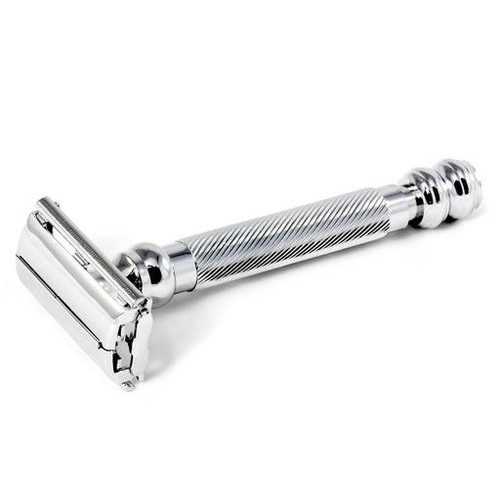
The truth about “pot metal”: Why does your razor break?
To understand why someone would be willing to spend hundreds of dollars to buy a safety razor, you first need to know where the cheaper models fall short.
90% of entry-level shavers on the market (including most well-known German brands) use a process called “Zamak die-casting.” In this industry, this material is often jokingly referred to as “pot metal.”
Its manufacturing logic is as follows:
- Molten zinc alloy is injected into a mold.
- It is cooled and shaped.
- Then polished and electroplated.
Characteristics of Zamak
- Advantages:
- Extremely cheap.
- Fast production speed.
- As long as the mold is fine, the product shape will be very consistent.
- Fatal flaw: Zamak alloy is extremely reactive and highly susceptible to corrosion.
- Once the surface chrome plating develops tiny scratches or peeling (which is almost unavoidable in a humid bathroom environment), the internal zinc alloy begins to corrode.
- This results in what is known as “Zamak Rot” (zinc corrosion).
This is why you often find cases of zinc alloy razors breaking—usually at the threaded joints.
It’s not just a matter of durability but also about tolerances. Because of the need for demolding and electroplating, the casting process cannot achieve the ultimate dimensional precision, which directly leads to the next problem: blade vibration.

The Art of Tolerance: How CNC Machines Eliminate Micro-vibrations
If you’re a geek who pursues the ultimate smoothness, you should pay attention to one word: tolerance.
In traditional cast shavers, the fit between the top cap and the base plate is often relatively loose to allow for easy demolding of parts and to allow for the thickness of the electroplating layer.
When you tighten the blade, although it appears to be fixed in place, under a microscope, the edge of the blade is actually suspended in the air, lacking strong support.
This leads to “blade chatter.”
When the safety razor cuts coarse, brittle hairs, the obstructed blades vibrate at micro-frequency. This vibration is transmitted to the skin and is the culprit behind the burning sensation (razor burn) and redness after shaving.
The advantage of modern CNC razors lies in “subtractive manufacturing.” Manufacturers use CNC machine tools to “carve” razors from a single solid block of 316L stainless steel or 6061 aerospace aluminum.
For example, in reviews of the Henson AL13, they claim that its tolerance is controlled within 0.0005 inches (approximately 0.0127 millimeters). What does this mean?
- Rigid clamping: The blade is firmly clamped between the top cover and the bottom plate, with almost no suspended area.
- Eliminate vibration: The blade becomes an integral part of the razor, no longer a thin, vibrating piece of steel.
Many users’ first reaction after using a high-end CNC razor is, “This razor is so gentle, I can’t even feel the blades, but my beard has mysteriously disappeared.” This is actually the physical effect of eliminating vibration.
Material determines fate: 316L stainless steel vs. aerospace aluminum
When deciding to upgrade to a CNC-level safety razor, you will typically face two material options: stainless steel and aluminum alloy.
1. 316L Stainless Steel (Marine Grade Stainless Steel)
This is the king of materials in the list of recommended stainless steel razors.
- Texture: High density, feels heavy in the hand. This weight allows you to shave entirely using gravity, without putting any pressure on your hands.
- Lifespan: Theoretically, it can be passed down to your grandchildren. It is corrosion-resistant and drop-resistant (although it may damage floor tiles) and can be polished and repaired.
- Notable works: Razorock Game Changer, Rex Ambassador, Wolfman.
2. Aircraft-Grade Aluminum
- Texture: Extremely light. This provides a completely different feel to the handling; you need to apply just a little force to control the direction, like driving a lightweight sports car.
- Color: Various vibrant colors can be achieved through anodizing (such as Henson’s vibrant color scheme).
- Note: Although aluminum does not rust, if the anodized layer is damaged, the aluminum may oxidize and turn white.
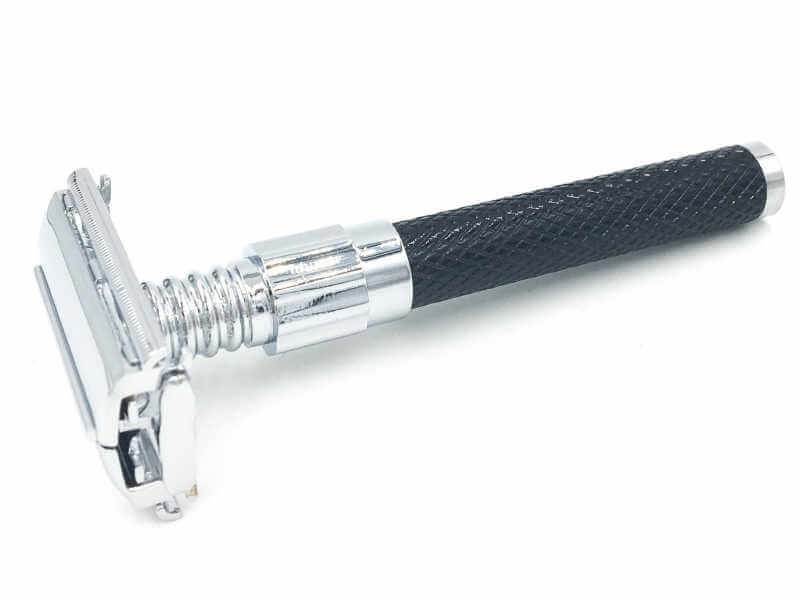
Is this kind of investment worthwhile? From “Consumer Goods” to “Family Heirlooms”
Returning to the question in the title: Is it worth paying ten times more?
If you view shaving as just a morning chore that you have to do, and as long as your face doesn’t hurt, a Merkur or Parker shaving gun costing a few tens of dollars will suffice.
Although they may break after a few years, the cost of buying a new one is not high.
However, if you view a safety razor as a lifestyle investment or an appreciation of industrial aesthetics, then the value of an all-steel CNC razor is irreplaceable.
This is somewhat like comparing a quartz watch to a mechanical watch. The former can tell time, but the latter represents humanity’s mastery of precision mechanics.
When you hold a razor milled from 316L stainless steel with patterns like works of art, you are no longer holding a simple sanitary utensil but a tool that can be used indefinitely.
Furthermore, for those who yearn for high-end vintage razors (such as the Gillette Fatboy or the British Aristocrat), modern CNC machining is essentially a spiritual successor to these classic brass razors.
They also pursue a pure, all-metal, unplated structure but take precision a step further.
Conclusion
In the world of safety razors, price doesn’t always equal a waste of money.
From Zamak die casting to CNC precision machining, the difference isn’t just about cost but also about the distance between “usable” and “perfect.”
A good CNC razor eliminates blade vibration through extremely precise tolerances, making shaving an enjoyable experience rather than a torment. Although the initial investment is higher, considering its near-permanent lifespan, it may be the most worthwhile investment you can make in your bathroom.
FAQ (Frequently Asked Questions)
Q1: Is a CNC-manufactured safety razor necessarily more aggressive than a cast one?
This is a common misconception. Aggressiveness depends primarily on the blade gap and blade exposure and has nothing to do with the manufacturing process.
In fact, because CNC machining allows for more precise tolerance control, many CNC shavers (such as the Henson AL13) are both highly efficient and extremely gentle, as they eliminate the risk of accidental cuts caused by rough workmanship.
Q2: Since stainless steel is so good, why do people still buy old-fashioned copper vintage razors?
High-end vintage razors (usually brass plated with nickel or gold) possess unique historical value and collectible appeal. Early Gillette razors, for example, were made entirely of brass and were extremely durable.
While modern CNC stainless steel razor handles may surpass them in precision, for collectors, the mechanical structure of vintage razor handles (such as the early TTO adjustable mechanism) and the patina of age are qualities that modern industrial products cannot fully replicate.
Q3: What is the difference between 316L and 303 stainless steel in razors?
In stainless steel razor recommendations, you’ll see these two grades. 316L is “medical grade” or “marine grade” stainless steel, containing molybdenum, making it extremely corrosion-resistant and completely unaffected by the humid environment of a bathroom.
303 stainless steel, on the other hand, has a higher sulfur content for easier machining, resulting in slightly less corrosion resistance than 316L.
For the average user, especially those living near the sea or in extremely humid environments, 316L is a better choice; however, in everyday use, there is virtually no difference in their durability.