Coming-of-age ceremony: Why is a safety razor the best gift a father can give his son?

Table of Contents
It was a subtle moment: as you watched your son eating breakfast, you suddenly noticed that the soft, downy hair above his lips had turned into a somewhat messy “shadow.” As a father, you realized that a new phase had begun.
Most parents’ instinctive reaction is to rush to the supermarket and buy a multi-blade plastic razor or order the latest electric razor online for their teenager’s first shave.
After all, they are advertised as “fast,” “convenient,” and “safe.”
But please pause before you click “Buy.”
Shaving is more than just removing facial hair; it’s a daily ritual marking a boy’s transition to manhood.
At this special juncture, gifting him a classic safety razor might carry a deeper educational and emotional significance than any electronic product. It’s not just a coming-of-age gift for your son but also an essential lesson in patience, focus, and self-respect.

Reject “fast food” grooming: Why do teenagers need single-blade razors more?
Many fathers worry that safety razors will injure beginners and therefore tend to choose electric shavers.
However, from a skin physiology perspective, this “protection” may actually harm teenagers’ skin.
1. Say goodbye to the nightmare of “ingrown hairs.”
Teenage skin is often accompanied by excessive sebum secretion and acne problems.
The mainstream multi-blade system (cartridge razors) on the market utilizes the “hysteresis effect”: the first blade pulls the hair out of the follicle, the second blade cuts it, and then the hair retracts under the skin.
For teenagers with delicate skin shaving for the first time, this can be a disaster. The retracted hair can easily get trapped in the follicle with oil, leading to ingrown hairs or worsening acne.
In contrast, the safety razor uses a single blade, which is known in the industry as a “flush cut.” It only cuts the hair on the surface of the skin without pulling or retracting. This not only reduces irritation to pimples but also physically eliminates the cause of pseudofolliculitis.
2. Establish a basic standard of hygiene
Electric shavers and multi-blade heads are breeding grounds for bacteria. Skin flakes, oil, and shaving cream residue can easily get stuck in the complex crevices of the blade head, making them difficult to clean thoroughly.
For an 18-year-old boy with a face full of collagen but a fragile skin barrier, this is a significant risk.
The safety razor, however, features a minimalist design; the blades are disassembled and rinsed after each use and even replaced with new blades every time, making it extremely cost-effective and ensuring absolute physical hygiene.
The Art of Slowing Down: Moments of Passing Down Between Father and Son
In this era saturated with short videos and instant gratification, teaching your child to shave may be one of the few moments of interaction between you that requires you to slow down.
If you give him an electric razor, he’ll hide in the bathroom and, accompanied by the noisy motor, rub it haphazardly a few times—it’s just a rigid “task.”
But if you give him a safety razor set, that becomes a “skill.” You’ll need to teach him:
- How to create dense foam (lathering).
- How to locate the direction of facial hair growth (mapping the grain).
- How to maintain the optimal cutting angle of 30 degrees, instead of pressing down hard like you would with a plastic knife holder.
This is a gift imbued with a profound sense of ritual for an 18-year-old boy.
In this process, you’re not just passing on shaving techniques but a philosophy of life: good results require preparation, patience, and focus.
As he stands before the mirror, carefully holding the heavy metal handle, he learns control over his own body. This passing of the torch between father and son is something no fully automatic machine can replace.

Break free from the “use and discard” consumer mindset
Today’s teenagers are growing up in a “disposable culture.” From plastic straws to fast fashion, everything seems temporary.
A high-quality safety razor, typically made of brass, stainless steel, or aerospace-grade aluminum, is the kind of item that can accompany him for decades and even be passed down to his son in the future.
This suitable gift for a new man implicitly teaches a set of values:
- Texture education: Let him feel the touch of metal knurling on his fingertips, which is different from cheap plastic.
- Environmental responsibility: Say goodbye to plastic blades that have to be thrown into the trash every month, and only produce recyclable metal blade waste.
When your son takes out this exquisite tool in his college dormitory, it represents not only a clean appearance but also a mature and sophisticated attitude towards life.
The weight of the first knife
When we talk about coming-of-age gifts for our sons, we often want to give them the best protection. But when it comes to shaving, the best protection isn’t keeping him away from sharp edges but teaching him how to handle them.
A safety razor is both a long-term investment in his skin health and a vote of confidence in his growth.
You tell him, “Son, I believe you have the ability to master this skill-based tool, just as I believe you have the ability to take control of your own life.”
On this special day, don’t just hand him an electric machine. Stand with him in front of the mirror, apply warm foam, pick up the metal razor, and complete this coronation that belongs to a man.
FAQ (Frequently Asked Questions)
Q1: Is the safety razor too dangerous for teenagers with no experience?
This is a common misconception among many parents.
Although it’s called a “blade,” the modern safety razor was designed to limit blade exposure through a safety bar.
As long as you choose a “mild” head suitable for beginners and follow the “zero pressure” principle (let the razor work on its own weight; don’t press hard), it’s actually less likely to cause cuts than multi-blade razors because it doesn’t cause users to unconsciously pull hard due to blockages.
Q2: I’m in a rush to get to school in the morning; would using a safety razor be too time-consuming?
There is indeed a learning curve at the beginning, which may take 10-15 minutes. But that’s precisely its value—it forces teenagers to wake up 10 minutes earlier to groom themselves and clear their heads.
Once the technique is mastered (usually taking 2-3 weeks), a standard single shave (with the grain) only takes 3-5 minutes, not much slower than an electric shaver, but the cleanliness is worlds apart.
Q3: Since it’s a gift for my son, what kind of configuration should I choose?
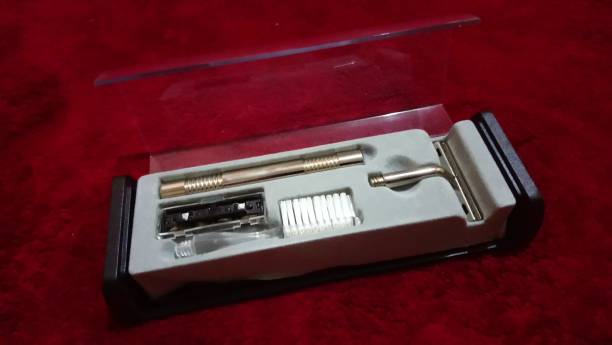
As a suitable gift for a shaving novice, it’s advisable not to buy just a knife. Instead, consider a complete “experience”:
- A gentle, closed-comb safety razor.
- A refreshingly scented shaving soap (avoiding the chemical irritation of cheap bottled foam).
- A soft synthetic fiber shaving brush.
This “full set” greatly enhances the ritualistic aspect of the gift, making him more willing to try and stick with it.